When Should I Sell My Rental Property?
I spend a lot of time in my published articles talking about the long-term benefits of rental property investing, the math behind it, how it actually works in the real world, and why rentals are a among the most lucrative investments available to everyday retail investors.
In essence, why and how to get INTO rental property investing. But what about the flip side: how do we know when it’s time to get OUT? In other words, when is it a good idea to SELL a rental property?
That’s the question I’m going to address in this article. Of course, sellers choose to liquidate their properties for all sorts of reasons, both personal and financial. Sometimes they’re forced into selling by circumstances outside their control, because they need the cash for an emergency, etc.
But in this post, I want to focus on the “good” reasons you might intentionally choose to sell a rental property. Here are the three best reasons, each of which I’ll cover in detail:
Re-deploying equity. Your equity in the property could be more productively invested elsewhere.
Circumstances changed. The investing thesis or expected returns have shifted since purchase, and the go-forward numbers no longer look appealing.
You bought a “lemon”. The property has underperformed expectations, and you don’t expect any improvement or stabilization.
For each of these circumstances, I’ll give a real-life example from my own portfolio to illustrate the logic and math behind selling. At the end, I’ll also touch on the “bad” reasons to sell a property, so that you don’t pull the plug for the wrong reasons.
Three “Good” Reasons to Sell a Rental Property
Reason #1 to Sell a Rental Property: Re-Deploying Equity
When first buying a property, many investors (myself included) are primarily concerned with cash-on-cash returns, or the expected cash yield on dollars invested. For example, if I invest $30K into a property between my down payment and closing costs, and I expect the property to generate $3K per year in positive cash flow, then the cash-on-cash returns are 10%. The formula looks like this:
Cash on Cash = annual cash flow / dollars invested
But that number isn’t static: making conservative long-term assumptions, we see that the cash-on-cash returns should naturally increase over the life of the investment. This is because rent and expenses will increase with inflation, but our mortgage payment never changes; so we “grow the gap” between revenue and expenses over time, and this larger profit compared to our same original cash invested means increasing cash-on-cash over time.
To illustrate this idea, here’s a graph from the Multi-Year Model in my Property Analyzer (available for free download btw):
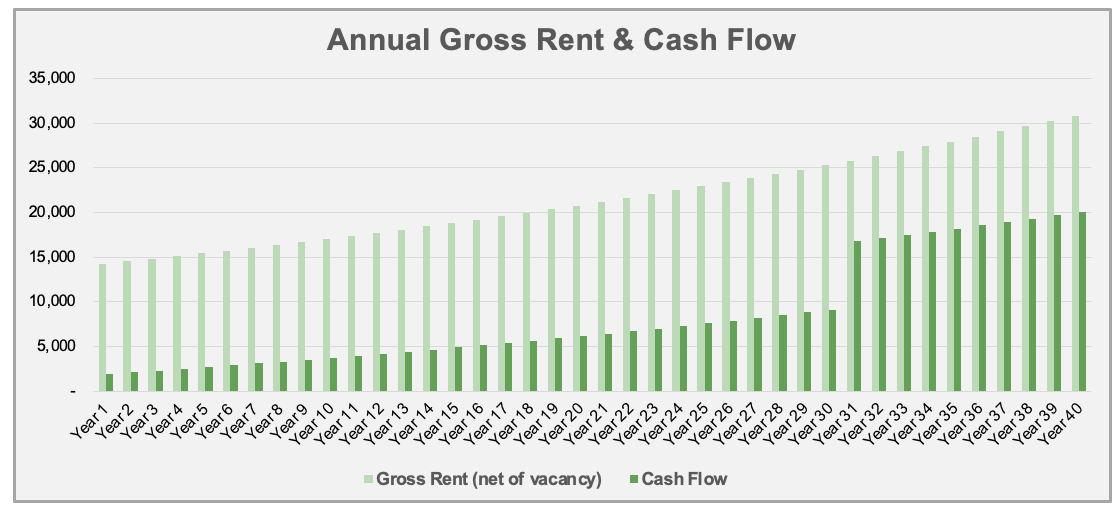
The dark green bar of cash flow rises over time, and assuming the same original dollars invested, that also means that the rate of cash returns increases (on a non-inflation-adjusted basis, of course.)
But another important ROI metric actually DECREASES over time: Cash on Equity. This is a measure of your cash returns compared to the amount of equity you have in the property at any given time. To get from cash-on-cash returns to cash-on-equity returns, we simply change the denominator from our original dollars invested to the amount of current equity we have:
Cash on Equity = annual cash flow / current equity
Equity in a rental property should increase over time. When you buy it, the only equity you have is your down payment, minus any closing costs you paid. But over time, your equity increases in two ways: first, the value of the property increases; and second, the amount owed on your mortgage decreases. Check out the rising green line on this graph, showing equity growing over time:
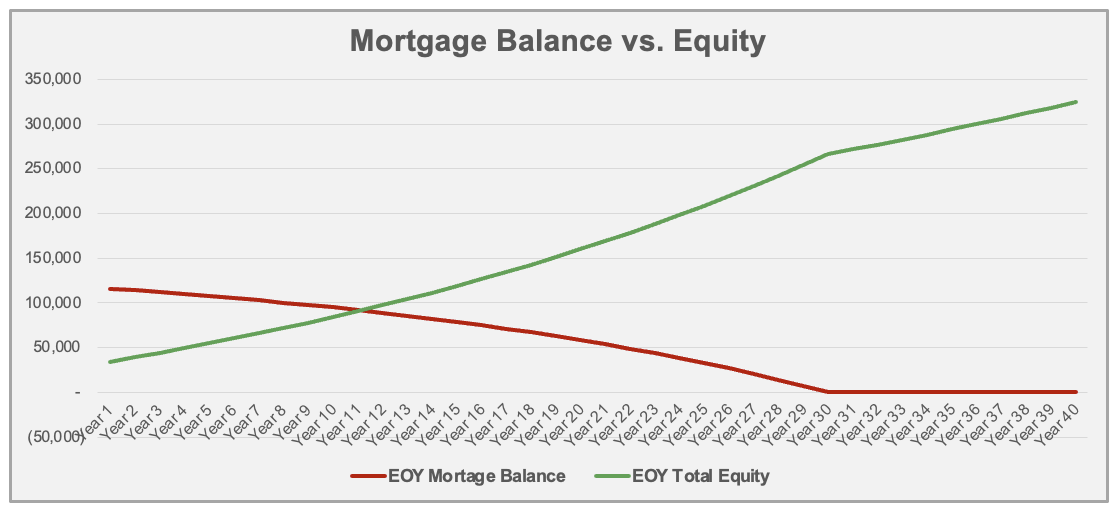
What does this all have to do with when to sell a rental property? Let me state it this way: if the equity in a rental property could be deployed more productively elsewhere, it’s reasonable to consider selling it.
More specifically: if the cash-on-equity of a rental property is significantly less than the cash-on-cash returns you could achieve in a new property or other investment, it’s reasonable to consider selling it.
In other words, even if your cash-on-cash is strong, you might have so much equity tied up in a property that it’s no longer optimal to hold it. (I’ll mention here that there are other ways to tap this equity, such as a cashout refi (i.e. get a new mortgage), a HELOC, or other methods…but this is an article about when to sell, so I’ll keep the focus there.)
BTW, if you do choose to sell in order to better invest your equity, you can avoid the tax implications of that sale (capital gains tax and depreciation recapture tax) by using a 1031 exchange. More on that strategy in this article.
Re-Deploying Equity: A Real-Life Example from My Portfolio
I could actually choose nearly any property from my portfolio as an example here. Thanks to the rapid run-up in home prices during the post-pandemic boom, nearly all my properties have experiences significant appreciation (and therefore significant equity growth) since I purchased them. But let me zoom in one particular property to illustrate: Property #6:
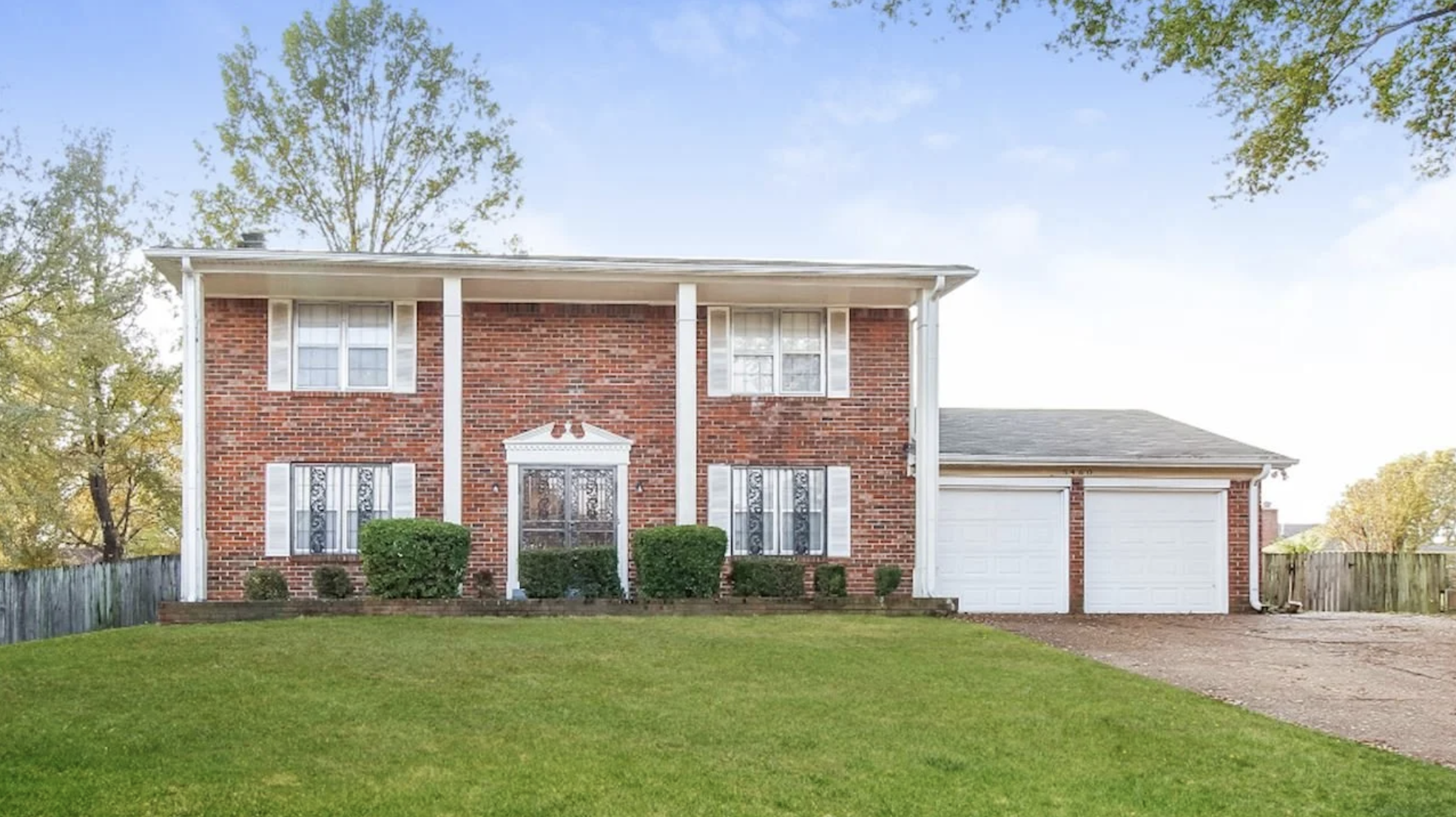
I bought this house in 2019 for $107,000, and my cash invested into the property was ~$35,000. But the house is now worth $211,000 according to Zillow, an increase of $104,000. Over that same time, my mortgage balance was reduced from $77,000 to $68,000. In total, then, my equity has increased $113,000, and now stands at just over $143,000.
My cash flow projections going forward are strong, at over $350/month, which translates into a 12% cash-on-cash return on my original $35K invested. However — and this is the key point — my cash-on-equity is a measly 3%.
If I were to liquidate my $143K in equity by selling the property, I’d be able to re-deploy it into new properties and get much more than $350/month total in positive cash flow. This would definitely be worth considering.
So why haven’t I done that yet, you might ask, for this property or any others? Well…it’s mostly inertia/laziness. Selling a property and buying others requires work, and just isn’t as easy as letting the original property ride. And while the additional cash flow would be nice, I don’t desparately need it. Perhaps if I did, I’d be move motivated to optimize the productivity of these invested dollars. The opportunity is certainly there.
Reason #2 to Sell a Rental Property: Circumstances Changed
With any rental property, you make a set of going-in assumptions to evaluate and justify the investment, such as:
The rent potential of the house
The maintenance & repair costs you will have
The vacancy rate you will experience
How much rent will grow over time
How much property taxes & insurance costs will grow over time
The trajectory of the neighborhood and overall investment market (which will influence home price appreciation and rental demand)
If any of these assumptions turns out to be wrong, you might find yourself in a situation where the reality of the investment no longer lives up to the initial expectations — and once that happens, you might be better off selling.
This can sometimes happen very quickly. For example, if you buy a house thinking it will rent for $1,500/mo., but you’re only able to get $1,300 for it the first time you list it, that will dramatically reshape your expectations of go-forward ROI.
But circumstances can also change many years after you buy a property. If your house is re-assessed for property tax purposes and your tax bill doubles, that might significantly cut into your expected future profits. Insurance premiums might also go up significantly, as we’ve seen recently in certain parts of the country.
You might also realize after many years that the trajectory of the neighborhood or market is not what you had hoped it would be, and you see better opportunities elsewhere.
Whether it happens right away, or later on, the impact is the same: when circumstances have changed, this should force a re-evaluation of the investment from that point forward. And the best decision might be to sell and re-invest elsewhere where circumstances look better.
Changing Circumstances: A Real-Life Example from My Portfolio
A good example of this from my portfolio is Property #23:
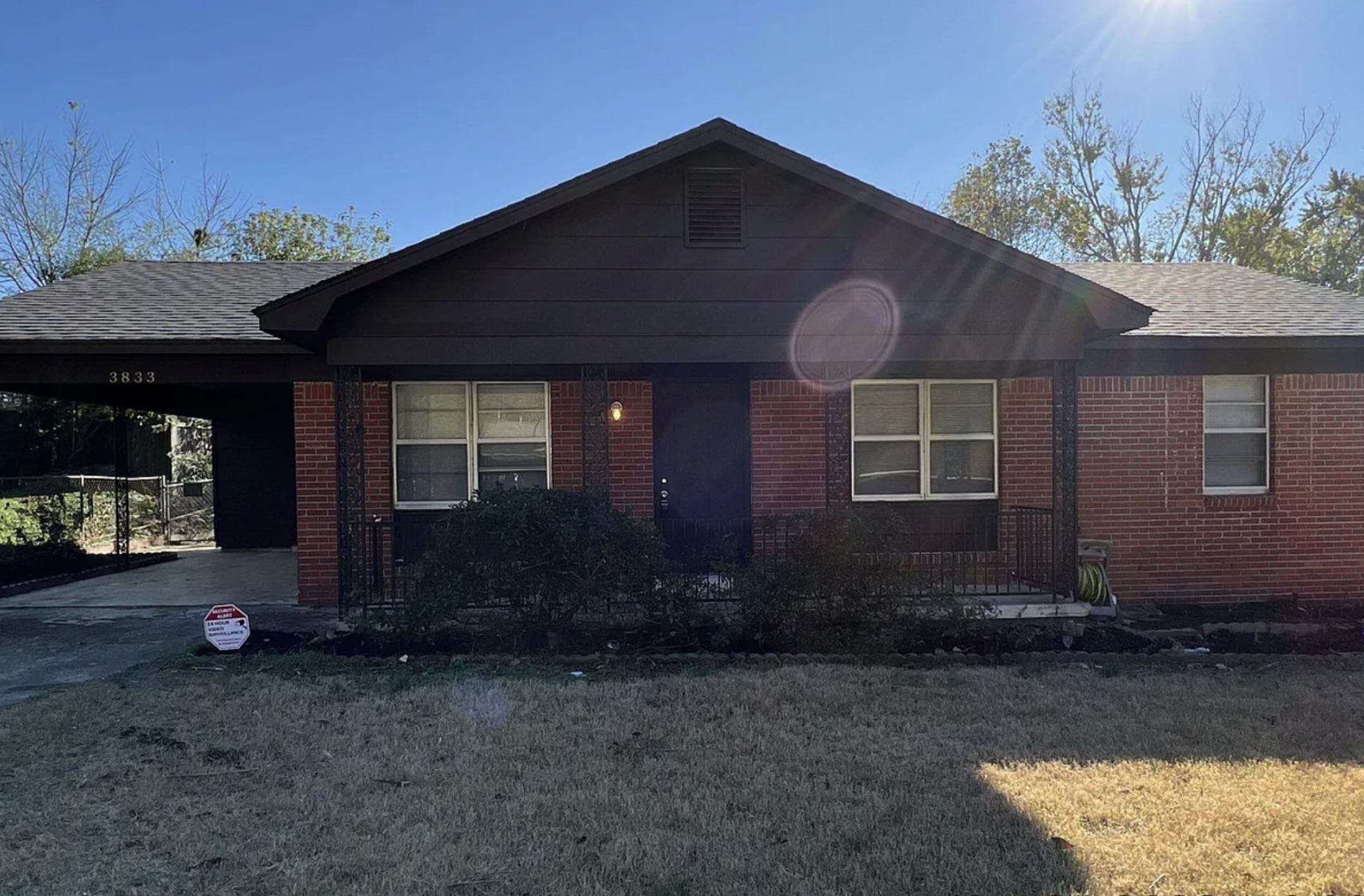
This was a turnkey property I bought in December 2022. The purchase price was $130K, and I expected it to rent for $1175. Unfortunately, we had to lower the price to $1095, and still struggled a bit to find a tenant.
And this wasn’t a fluke: several years later, I turned the property and re-listed it, and once again it took 3+ months to rent it at $1100. Property taxes have also increased significantly since I bought this house.
As of the time of writing, that tenant has renewed for another year at $1150. But even with that increase, my cash-on-cash returns are a measly 2.8%. The numbers just aren’t what I hoped they would be, so at some point, it might be worth selling this house, and investing my equity elsewhere.
This illustrates the importance of not just creating a pro forma at the time of purchase, but UPDATING that pro forma as your inputs change over time so that you know what your go-forward expectations are even when circumstances change.
Reason #3 to Sell a Rental Property: You Bought a “Lemon”
When buying a rental property, we try to make reasonable assumptions about what it will cost to maintain the property, fix issues that arise, and replace the key components of the house over time (such as the roof, HVAC, and so on.)
Sometimes, those assumptions turn out be very wrong.
Still, even if maintenance costs are high in the first few years, we still hope the property will eventually stabilize at a lower cost level. And most of the time that’s exactly what happens.
But if the property has failed to stabilize after 3+ years and is still draining a ton of cash, it may be time to pull the plug. There’s no rule that says you have to hold onto a money pit.
Buying a Lemon: A Real-Life Example from My Portfolio
If you’ve a devoted reader of the blog, you might know that the most infamous property in my portfolio is Property #7:
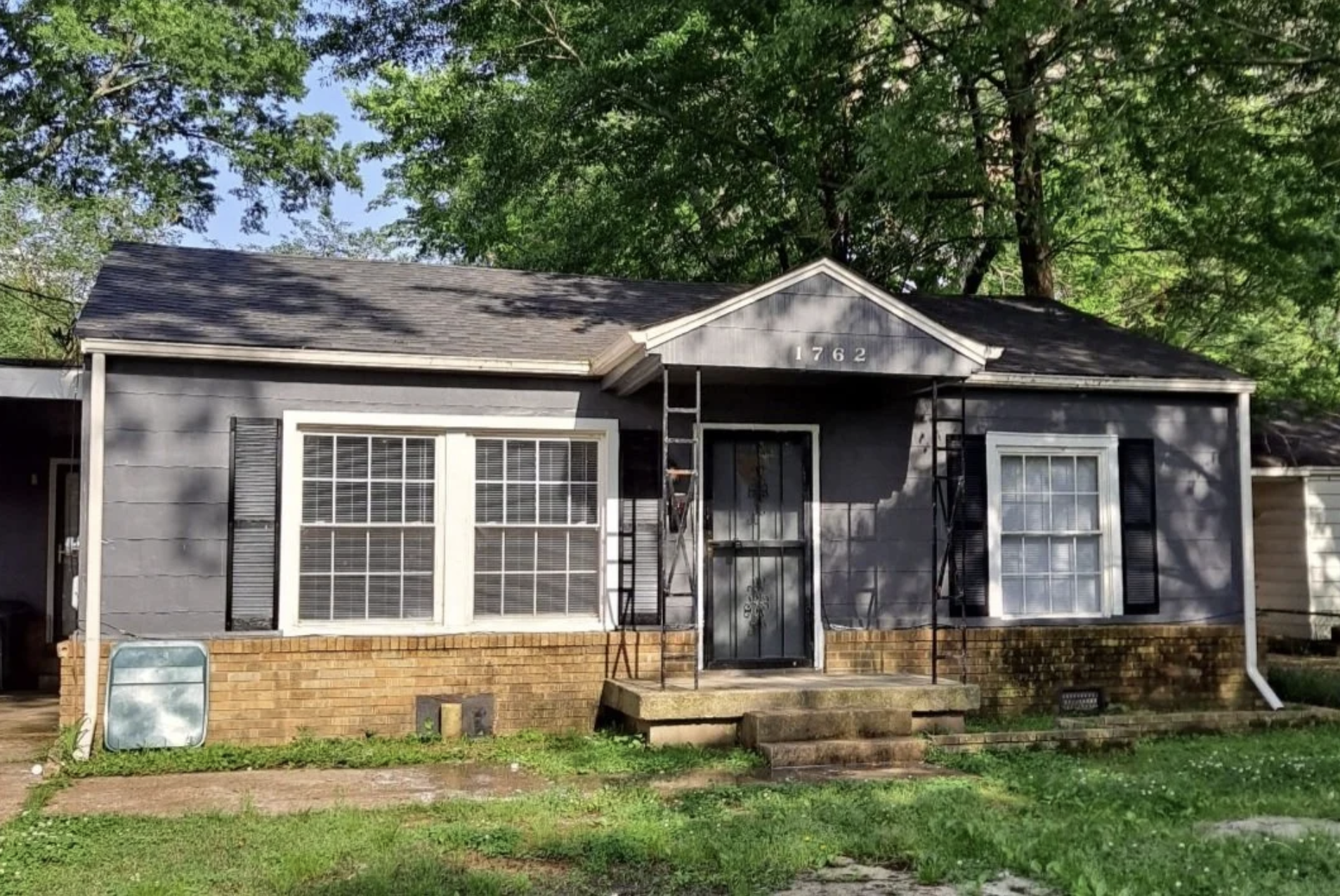
I bought this house in 2019, and it has been nearly non-stop issues since then. I’ve still managed positive ROI on the property, but that’s mostly due to 1) the fact that I never had a mortgage on it, and 2) the steep increase in home values after the pandemic.
Here’s the incredible list of things that have happened here:
water damage that led to replacement of more than half the walls and ceilings
expensive $15K roof replacement (complex roof system & carport roof)
large honeybee colony nested in the walls THREE different times (!)
sewer break under the house…messy, expensive cleanup
subfloor replaced, along with all ductwork under the house
turned twice at a total cost of nearly $14K
and so much more
I have stubbornly held on to the property, figuring that EVENTUALLY it would have to stabilize. And it did, briefly, in 2022-2023. But the problems just kept coming after that. And at this point, I’m not confident it’s going to get better in the future.
So it may be time to offload this house, as it has persistently been a costly headache to own over 7+ years.
Bad Reasons to Sell a Rental Property
There are many more bad reasons to sell a rental property than good reasons. I’ve encountered lots of these bad reasons over my many years of investing and working with private clients on their portfolios.
Here are three of the most common ones I hear:
Bad Reason #1: Variance/Bad Luck
This is the king of bad reasons to sell a rental. Like any investment, an individual rental property will have good years and bad years. If you happen to have an unwelcome surprise out of the gates that leads to a bad year, this is NOT a reason to sell. It’s a reason to keep holding so that your future good years will negate the impact of the bad year.
Notice that this is different from Good Reason #3 (buying a lemon, which will take many years to recognize), and also different from Good Reason #2 (the circumstances or thesis of the investment changing.) If you’ve just experienced normal variance/spikiness in the early years, keep holding.
Bad Reason #2: Need the Cash
If you buy a rental property, you should plan to hold it for at least a decade — longer is better. So you don’t want to encounter a situation where you’ve owned a property for a few years, and then need the cash for something else. Holding a rental for a few years is almost always a losing proposition, because 1) the early years are the skinniest when it comes to cash flow, and 2) the costs of buying and selling a house are high.
Obviously, life happens, and sometimes this circumstance can’t be avoided. But try to avoid it any way you can.
Bad Reason #3: Trading Up
Some investors think that single family homes are just a starting point to their investing journey, and that they won’t “make it” until they trade up into other asset classes such as large multifamily, commercial properties, etc.
But again, unless you’re already at the point where Good Reason #1 (re-deploying equity) has come into play, selling a rental in the early years to trade up means that your original investment in the house was likely a dud. The magic is in the out years!
Plus: single family rentals have a lot of advantages over those other asset classes — access to conventional mortgages, easier to buy and sell when needed, stable demand through economic cycles, and more — so in my book, the idea that you need to trade up to be a successful investor is flawed from the outset.
Conclusion
As buy-and-hold investors, we generally want to do what the name suggests: buy, and then hold for the long term. This is the most lucrative play, because transaction costs are relatively high, and the richest rewards in rental investing come in the out years.
But it’s also wise to recognize the right time to sell. You may want to consider liquidating a rental property if at least one of these things is true:
You have built up a lot of equity that could be better deployed elsewhere
Circumstances have changed, and you no longer like the go-forward ROI expectations
The house is a money pit, and you see no path to stabilization
About the Author
Hi, I’m Eric! I used cash-flowing rental properties to leave my corporate career at age 39. I started Rental Income Advisors in 2020 to help other people achieve their own goals through real estate investing.
My blog focuses on learning & education for new investors, and I make numerous tools & resources available for free, including my industry-leading Rental Property Analyzer.
I also now serve as a coach to dozens of private clients starting their own journeys investing in rental properties, and have helped my clients buy millions of dollars (and counting) in real estate. To chat with me about coaching, schedule a free initial consultation.


















As a rental investor, it’s usually best to hold rental properties for the long term. But eventually, it may be best to sell — so how do you know when it’s time to sell a rental property? Here are the three best reasons to sell a rental property, with real-life examples from my rental portfolio.