
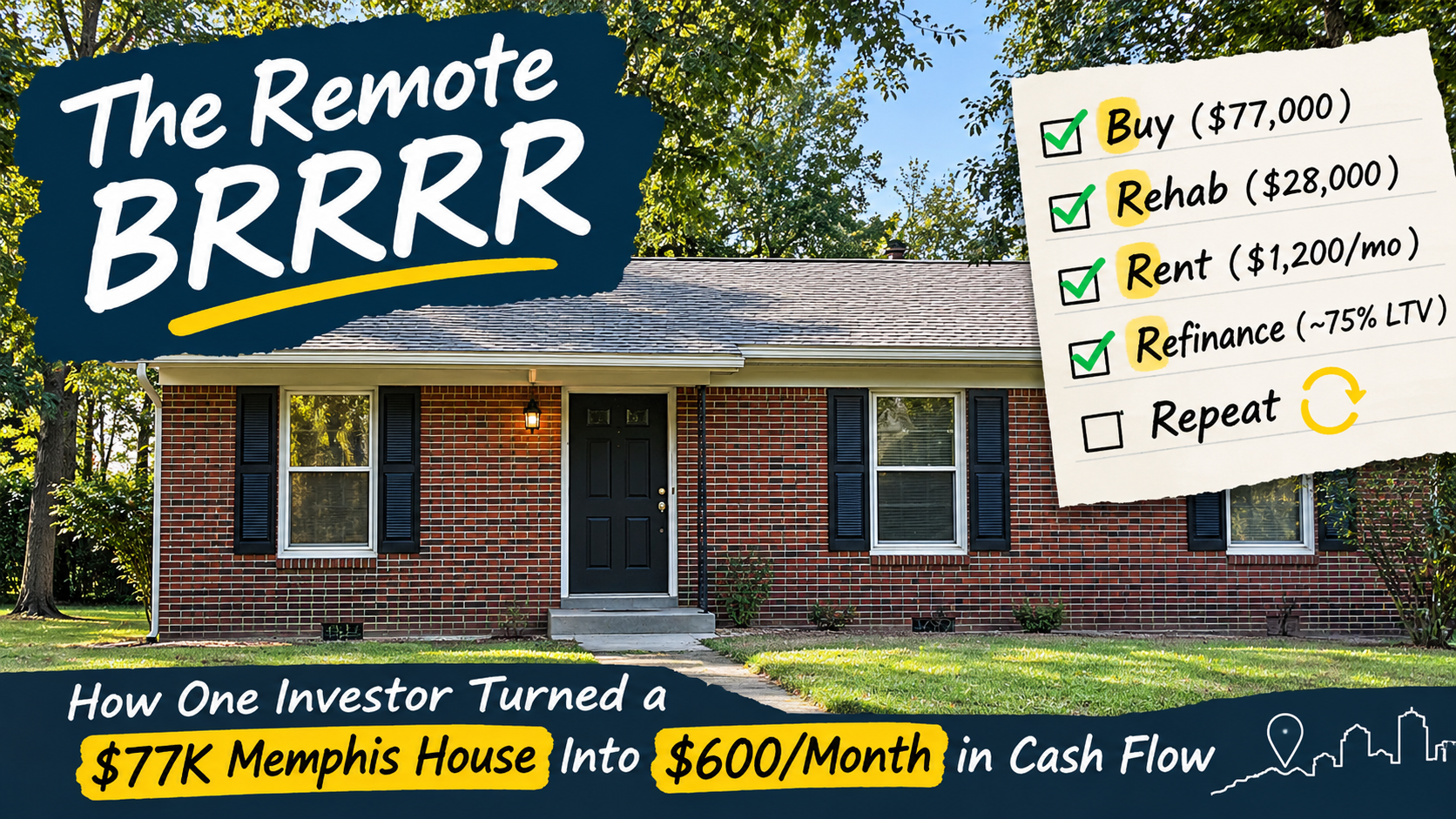
One of my favorite things about rental property investing is that it’s a simple strategy that is ALSO very powerful financially. You can buy a fully renovated rental property, put a conventional mortgage on it, hire a property manager, and start collecting rent. Simple, boring — but likely to be very profitable over the long term (as I’ve done my best to demonstrate over the last six years writing this blog!)
But there's another approach that can produce even better returns, if you're willing to take on a little more work and risk. It's called the BRRRR strategy (Buy, Rehab, Rent, Refinance, Repeat). I’ve written about this approach numerous times already on the blog, and one of my own properties (Property #18) was a BRRRR.
The basic idea is to purchase a property that needs some work, renovate it, place a tenant, and then refinance based on the property's improved value. Ideally, you get back much of the money you originally invested, allowing you to use that capital to buy another property. Rinse and repeat.
If you've spent much time consuming real estate investing content, you've probably heard about BRRRR. It’s an effective and well-liked strategy that offers several key benefits:
The ability to scale a rental portfolio will less capital by leaving less money in each deal (or sometimes no money at all)
Achieving higher cash-on-cash returns (the rate of cash yield on your dollars invested)
Creating “instant equity” through forced appreciation such that the after-rehab value exceeds purchase price + rehab costs
To illustrate how this works in practice, I recently sat down with a coaching client of mine to discuss a recent BRRRR deal he completed. This client prefers to remain anonymous, so I’ll use the pseudonym Frank for this article. Frank lives in San Francisco, works full-time in tech, and has never lived in Memphis. In other words, he's a true remote investor. Two years after starting coaching with me, he had built a portfolio of nine Memphis rental properties that were generating about $2,500 per month in cash flow — over $250/mo. per property.
But his 10th property was a BRRRR deal, and the numbers he achieved with that deal caught my attention. He purchased a house for $77,000, invested another $22,000 in renovations, and ended up with a property appraised at $143,000. After refinancing, he expected to generate approximately $600 per month in cash flow, with a projected cash-on-cash return of 23%.
Those are exceptional numbers. So I wanted to understand exactly how he did it, what made this deal work, and what lessons other remote investors could take away. Here's what we learned.
How Does the BRRRR Strategy Work?
First, let's start with the basics. BRRRR is an acronym for the five steps in the process:
Buy: Purchase a property, ideally at a discount to its potential value.
Rehab: Renovate the property to improve its condition, rental potential, and market value.
Rent: Place a tenant and establish the property's rental income.
Refinance: Obtain a long-term mortgage based on the improved value of the property, recovering some of your initial investment.
Repeat: Use the recovered capital to purchase your next property.
The critical difference between BRRRR and a conventional rental purchase is the timing of the financing. With a traditional rental purchase, you might put 25% down and finance the other 75% with a mortgage from day one. With BRRRR, you generally purchase the property with cash or short-term financing, complete the renovation, and then obtain a permanent mortgage.
Why go through all that trouble? Because the bank may be willing to lend against the property's new value, rather than what you originally paid for it.
Consider a hypothetical example. You buy a distressed property for $80,000 and spend $20,000 fixing it up. Your total investment is $100,000, excluding transaction costs. After the renovation, the property appraises for $120,000. If a lender is willing to provide a cash-out refinance at 75% loan-to-value (LTV), you could potentially obtain a mortgage of $90,000. That's enough to recover all but $10,000 of your original investment. You now own a renovated rental property, have a tenant paying rent, and have recovered most of the capital you used to purchase and renovate the house.
Sounds pretty good, right?
Of course, there’s more risk in this approach than a traditional deal. You have to find the right property — one where you can add significant value but won’t become a money pit. You have to manage the rehab successfully and on-budget. You have to place a tenant at your expected rent, or else your final numbers may fall short. And you need your appraisal to come in at the ARV (after-rehab value) that you assumed in your original numbers.
So there’s a lot that can go sideways. Still, when the pieces come together, BRRRR can be a powerful strategy. And Frank’s deal is an excellent real-world example of that.
Meet Frank: From Conventional Rentals to BRRRR
Like many of my clients, Frank lives in an expensive coastal market where purchasing rental properties for cash flow is difficult. He was attracted to Memphis because he could buy houses for a fraction of what comparable properties would cost in San Francisco, while generating much healthier rental yields.
His long-term goal is straightforward: build enough cash flow from rental properties to eventually replace his W-2 income. He started with conventional rental purchases. In fact, I worked with him directly on his first several properties, none of which were BRRRR deals. Only after gaining some experience did he begin experimenting with properties that needed more extensive renovations.
By the time we spoke, he had completed or was working on his fifth BRRRR, and he was loving the results. He was consistently finding better returns using BRRRR than he had achieved with his earlier conventional purchases.
I think this progression is worth emphasizing. Frank didn't jump into remote rehabs on day one. He first learned the Memphis market, assembled a local team, gained experience analyzing deals, and became comfortable owning and operating rental properties from a distance. Only then did he start taking on more complicated projects. For most people, I think that's a smart way to approach it.
There's plenty to learn when you're buying your first rental property. Adding a major renovation to the mix creates another layer of complexity, and another set of things that can go wrong. For beginners, I generally prefer to keep things simple. But once you've developed some experience and a reliable local team, BRRRR can be a logical next step.
The Deal: A $77,000 House in Memphis
Time for the good stuff — let's get into the numbers!
Frank found a property in a working-class C neighborhood in Memphis. The house was listed on the MLS and had previously gone under contract before returning to the market. That made it an interesting candidate for an aggressive cash offer. Frank initially went under contract at $80,000, then negotiated the purchase price down to $77,000. The house needed approximately $22,000 in renovations.
Here are the key figures:
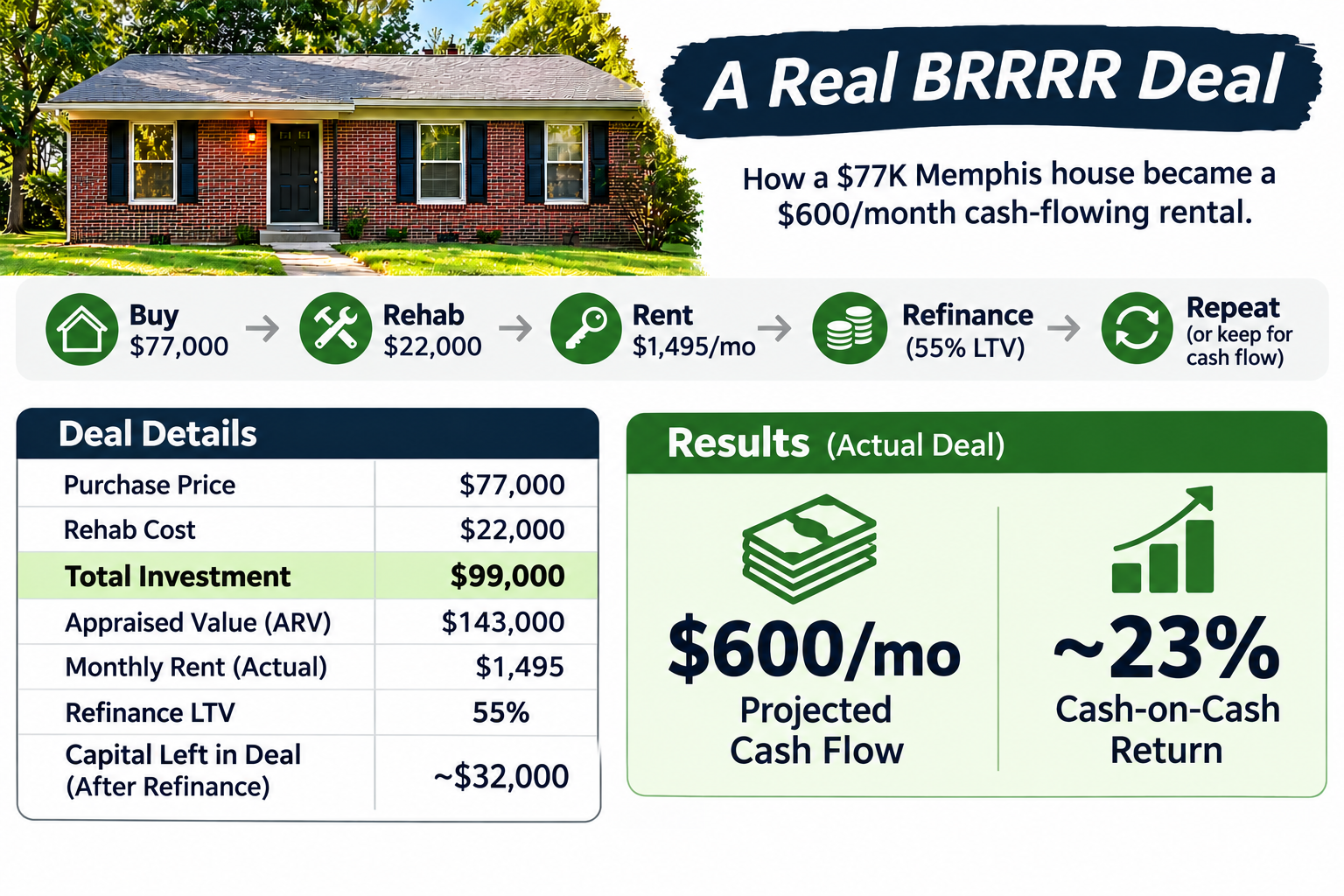
The first thing that jumps out is the difference between his total purchase-and-rehab cost and the final appraisal. He invested $99,000 in the property before transaction and financing costs, and it appraised for $143,000. That's a $44,000 difference.
Now, that doesn't mean he made $44,000 in profit. He still had closing costs and financing costs that I’ve left out of this example for the sake of simplicity. And an appraisal is not the same thing as a completed sale. But it does mean he created—or at least acquired—substantial equity relative to his cost basis.
And a big reason for that was a clever renovation.
Lesson #1: The Best BRRRRs Add Value
When most people think about rehabbing a rental property, they imagine replacing flooring, painting walls, installing new kitchen cabinets, and fixing whatever happens to be broken.
That's certainly part of it. But Frank takes the concept a step further. He looks for opportunities to change the property itself in ways that make it more valuable to tenants and future buyers.
In this particular case, the house was originally a three-bedroom, 1.5-bathroom property. Frank noticed two things. First, the house had an unusually large dining room that could be converted into an additional bedroom. Second, the half bathroom had enough wasted space to accommodate a shower, converting it into a full bathroom.
The result? A three-bedroom, 1.5-bathroom house became a four-bedroom, two-bathroom house. This makes the house significantly more valuable, and also adds hundreds of dollars to its monthly rent potential. In our conversation, Frank estimated that a typical three-bedroom, 1.5-bathroom house in that part of Memphis might rent for around $1,100 per month, while a four-bedroom, two-bathroom house could command roughly $1,300–$1,400.
I thought those estimates were reasonable, perhaps a little optimistic at high end. But still, by doing the value-add work to turn the property into a 4/2, Frank potentially increased the property's market rent by $200–$300 per month. That's an additional $2,400–$3,600 in gross annual rent. And unlike a one-time discount on the purchase price, the benefit of that additional bedroom can continue for as long as he owns the property.
Of course, there's a second benefit, too: the conversion can increase the property's appraised value. In fact, I suggested to Frank that a renovated three-bedroom version of his house might have appraised somewhere around $110,000–$115,000. Instead, the actual appraisal for his 4/2 came in at $143,000.
This is what I would call a genuine value-add opportunity. You're not just making the property prettier. You're changing its utility.
Of course, this only works if the conversion is done properly. Bedrooms need to meet applicable requirements, bathrooms need appropriate plumbing and ventilation, and so on. You should also be careful about over-improving a property for its neighborhood. Installing a $30,000 luxury kitchen in a $100,000 rental house probably isn't going to produce a good return.
But spending a relatively modest amount to create a legitimate additional bedroom? That can be a real winner.
Lesson #2: Remote BRRRR Investing Is a Team Sport
Here's a question I often get from prospective investors and my coaching clients: how can you possibly manage a major renovation on a house that's hundreds or thousands of miles away?
The simple answer is that you need the right local partners. And in my view, the most important partner for any remote rental investor is the property manager. That's true for any kind of remote rental property, but it’s especially true for BRRRR deals. An agent can also play an important role. Let’s take a look at how a remote BRRRR actually gets done on the ground.
Start with an experienced local agent
Frank finds his properties on the MLS, often using Zillow. That's worth noting because there's a common perception that successful BRRRR investors need access to some secret network of wholesalers or off-market deals. This just isn’t true.
Frank has explored wholesalers, but his successful purchases have come from ordinary MLS listings. He looks for distressed or overlooked properties where he believes he can negotiate a favorable price. Once he identifies a candidate, his local agent evaluates the property and gives him an initial assessment of its condition and renovation needs.
This is a first-pass screening, not a substitute for proper due diligence. If the numbers still look promising, Frank moves forward with an offer.
Get a detailed rehab scope before closing
This is probably the most important part of Frank’s process. Once he's under contract, he has his property manager inspect the house and prepare a detailed scope of work. (If your property manager isn’t willing to do this, you can do the same thing with a local general contractor — but in the end it should always be the property manager that is responsible and accountable for the work.)
Frank wants to know what the renovation will cost BEFORE he commits to buying the house. On a BRRRR deal, this is a critical piece of due diligence that ensures his original financial assumptions are sound.
I would add one important distinction here. A rehab inspection is not the same thing as an independent home inspection. The rehab inspection tells you what work is needed to make the property rent-ready and how much that work is likely to cost. A licensed home inspector evaluates the condition of the house, including major systems, structural concerns, safety issues, and defects that might not be included in a cosmetic renovation estimate.
For a substantial BRRRR project, I would generally want both. You don't want to discover after closing that your $22,000 renovation also requires an unexpected $15,000 foundation repair.
Lesson #3: Buying With Cash Gives You Flexibility
Frank purchases his BRRRR properties with his own cash. This is an advantage that not every investor has, but it simplifies the process considerably.
For starters, cash offers can be attractive to sellers. There's no mortgage approval contingency, fewer financing-related delays, and potentially a faster closing. That can provide negotiating leverage, especially when a property needs substantial work or has already fallen out of contract.
Cash also eliminates the cost and complexity of short-term acquisition financing. Some BRRRR investors use hard-money loans or other short-term financing to purchase and renovate properties. But these loans can come with high interest rates, origination fees, short maturities, and extension costs. And if your renovation runs over budget, takes longer than expected, or your refinance doesn't work out, those financing costs can become painful in a hurry.
Using cash avoids those particular risks. The trade-off, of course, is that you need to have the money available in the first place. In Frank’s case, he had approximately $99,000 tied up in the purchase and rehab, plus transaction and carrying costs, until the refinance. That's a meaningful amount of capital — and remember, during the renovation period, the property isn't generating rental income.
There are other options to procuring the initial capital that also avoid the costs and risks of short-term financing. If you have a HELOC (home equity line of credit), for example on your primary residence, you can use those funds for the initial purchase and rehab, and then pay yourself back once you get your long-term financing. Taking a temporary loan from your 401(k) or IRA is also an option.
If that all fails, and you don’t have enough cash, hard-money loans are certainly an option — and many BRRRR investors and house flippers use them. Just be aware of the terms of those loans, and the resulting risks.
Lesson #4: The Two Most Important Numbers Are Rent and ARV
One thing I liked about Frank’s approach is how systematically he underwrites his deals. By the time he's ready to close, he wants to have most of the important numbers nailed down:
He knows the negotiated purchase price
He has a detailed rehab estimate
He has obtained preliminary loan terms from lenders
That leaves two major variables that are harder to know with certainty: the property's eventual rent and its after-repair value. These are the same two numbers that I spend a tremendous amount of time teaching my coaching clients to estimate. And with BRRRR, they're particularly important.
Estimating the rent
For a conventional rental purchase, rent is one of the biggest determinants of cash flow. With BRRRR, that's still true.
But the rent also affects how much debt the property can comfortably support. If you expect a renovated property to rent for $1,400 but in the end you only get $1,200, that's a meaningful difference. You're losing $2,400 in annual gross income before accounting for operating expenses.
On this deal, Frank originally underwrote his property at approximately $1,300 per month. In a nice surprise, he chose to list it a bit higher at $1,495, and it rented at that price to a Section 8 tenant (the federal rent-assistance program.)
Section 8 can sometimes produce attractive rental income, but it also brings additional requirements and considerations. And you shouldn't assume that a favorable voucher rent will be available on every property. I always advise to underwrite a deal based on realistic market rent, treating any Section 8 premium as potential upside — which is exactly what Frank did here.
Estimating the ARV
ARV (after-rehab value) is what you expect the property to be worth once the renovation is complete. When a BRRRR investor gets their long-term financing, the lender will send an appraiser to the property to determine its market value, which is then used as a basis for the loan.
This is where a lot of BRRRR deals get into trouble. Suppose you purchase a house for $80,000 and spend $30,000 renovating it. Your total investment is $110,000 before transaction costs. You expect it to appraise for $150,000, allowing you to borrow $112,500 at 75% LTV.
But what happens if the appraisal comes in at $125,000 instead? Now a 75% loan would be only $93,750, almost $19,000 less financing than you expected. You could still have a perfectly good rental property, but your ability to recover capital and repeat the process has changed dramatically.
That's why you need to be conservative when estimating ARV. Look carefully at comparable sales. Pay attention to location, condition, size, bedroom and bathroom count, and the actual properties an appraiser is likely to use. And remember that the appraisal is ultimately outside your control.
If you only model your deals based on a best-case scenario, you’re likely to be disappointed. Consider a full range of possible outcomes with BRRRR deals, and be sure you’d still be happy with a middle-of-the-road outcome.
Lesson #5: More Leverage Isn’t Always Better
Now we get to my favorite part of Frank’s deal.
After completing the renovation and placing a tenant, Frank had a property appraised at $143,000. He could potentially have taken out a relatively large mortgage, recovered all or most of his invested capital, and moved on to the next property. That's the classic BRRRR playbook.
But Frank did something different. He modeled ten different refinancing scenarios, varying the loan-to-value ratio, interest rate, and points paid to the lender. Then he compared how each option affected the amount of capital remaining in the property, monthly cash flow, and cash-on-cash return.
Here's a simplified look at five of the scenarios we discussed:
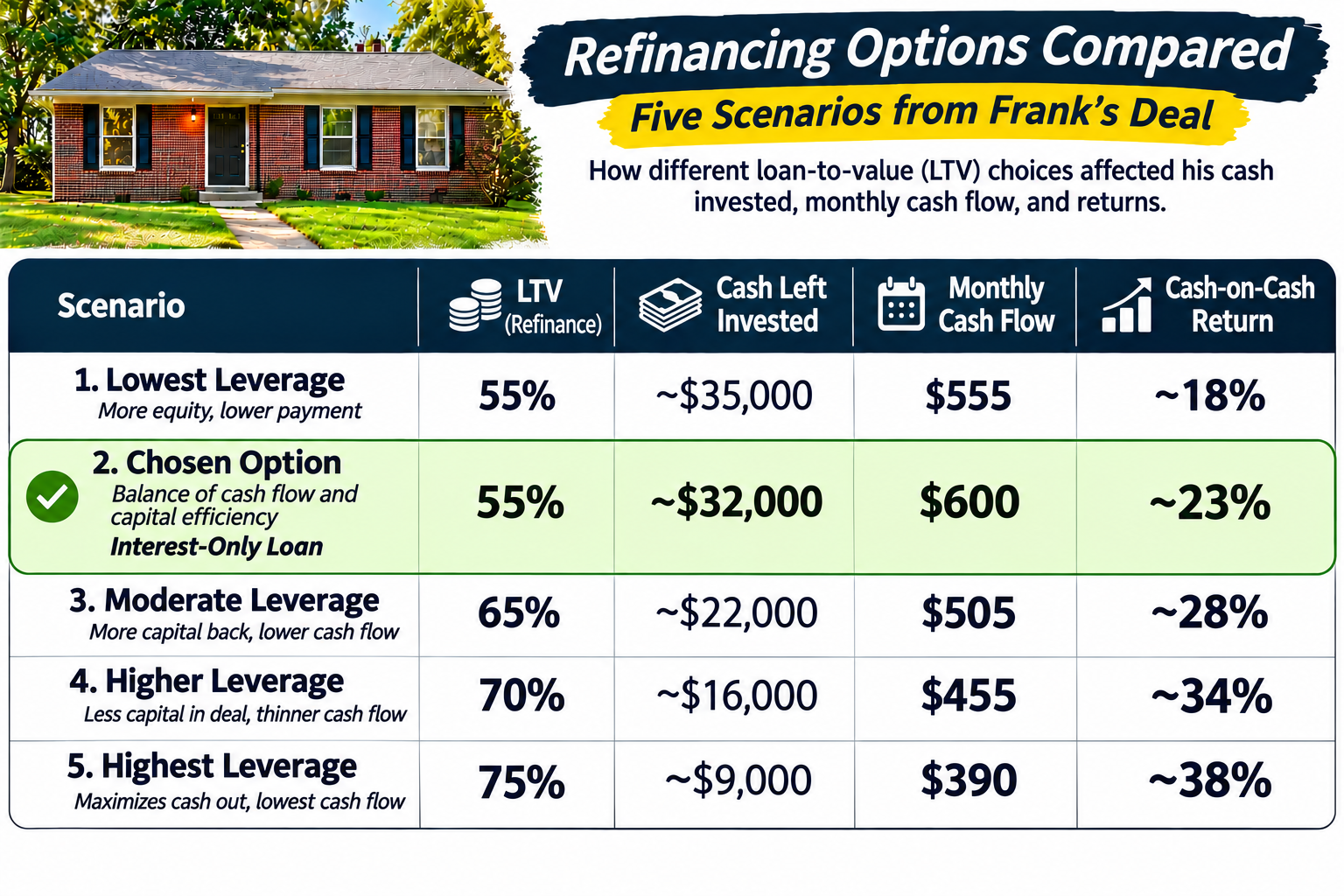
At first glance, the highest-leverage scenario looks like the obvious winner. Who wouldn’t want a 38% cash-on-cash return?
But when you look at the actual monthly cash flow, it’s the lowest at $390. And you’ve left only $9K invested in the deal. Both these figures are important for deciding on the size of your loan at the Refinance step. There choice really depends on what you're trying to accomplish.
The case for maximizing your cash-out
Pulling the maximum amount of money out of the deal can be a powerful approach for investors with limited capital to invest.
Let's say you have $100,000 available to invest. Your goal is to build a portfolio as quickly as possible, and you don't have a lot of additional capital coming in. In that situation, recovering as much money as possible from each BRRRR may be extremely valuable. If you can get nearly all your money back, you can use it to buy another property, then another, then another.
Instead of purchasing two or three properties with your initial capital, perhaps you can eventually buy five or six. That larger portfolio can give you more exposure to long-term appreciation, mortgage paydown, and the tax advantages of rental property ownership.
There's nothing wrong with that approach — it's one of the reasons BRRRR is attractive in the first place. But there's a trade-off.
The case for leaving money in the deal
There are two big downsides to maxing out your cashout refi: lower nominal cash flow and the need to do more deals.
When you borrow more money against a rental property, your mortgage payment increases, which reduces your expected monthly cash flow. And when cash flow gets skinny, small problems become bigger problems. A $1,000 plumbing repair is annoying when your property generates $600 per month; it's considerably more painful when the property generates only $100 per month.
In Frank’s deal, he would still have a (very healthy) $390 in monthly cash flow with the biggest available loan. But imagine if the biggest loan left you with almost no cash flow — would you still think that’s a good option?
Frank recognized that his capital was being invested very productively even if he left $32,000 in the property. A projected 23% annual cash-on-cash return is excellent, and there’s no guarantee that the next deal will be as successful. Viewed that way, we might prefer to keep MORE money in the deal because of the rate of return is so good. In this case, Frank decided he'd rather have the stronger cash flow, and I think that's a perfectly sensible decision.
And it illustrates something that often gets lost in BRRRR discussions. The goal isn't necessarily to get all your money back. The goal is to make the best possible investment for your situation and goals.
Sometimes that means maximizing the cash you recover. Other times it means leaving more equity in the property and enjoying stronger cash flow. The right answer depends on your capital, your goals, your risk tolerance, and the time & energy you have to devote to your portfolio
Lesson #6: Understand ALL Your Lending Options
Getting the best rates
It’s common for lenders to offer better interest rates on loans with lower LTV’s, because the less you borrow, the less risky the loan is to the lender. This is true for conventional loans at closing, and it’s also true for cashout refi’s in BRRRR deals.
In this deal, Frank found that some lenders offered meaningfully better rates at lower LTV ratios. In certain cases, the difference between borrowing at 75% LTV and 55% LTV was as much as 1.0-1.5 percentage points, which is quite substantial. In fact, Frank couldn't reduce his leverage as much as he might have liked because his lender had a minimum loan size of approximately $75,000.
The lesson is to shop multiple loan scenarios and multiple lenders. Ask what happens to the rate at 75%, 70%, 65%, 60%, and 55% LTV. Ask about points, closing costs, prepayment penalties, and minimum loan amounts. When you run the numbers on all the scenarios, you might be surprised by where the sweet spot ends up.
Consider interest-only loans, but carefully
Frank made one additional financing decision that deserves attention: for this property, he chose an interest-only loan.
This was his first time using that structure. With a conventional amortizing mortgage, your monthly payment includes both interest and principal. Over time, your loan balance gradually declines. That's one of the long-term wealth-building advantages of rental property investing: your tenants are effectively helping you pay down the mortgage.
With an interest-only loan, you pay only the interest for an initial period. In Frank’s case, that period was ten years. After ten years, the loan is scheduled to begin amortizing over the remaining thirty years.
The advantage is straightforward. Your mortgage payment is lower during the interest-only period, leaving more rental income in your pocket each month. You’re basically taking the portion of the payment that WOULD go toward paying down the principal, and instead keeping that money as cash.
The disadvantage is equally straightforward. You're not paying down principal during those first ten years, and therefore not building equity in the property. And when the interest-only period ends, your monthly payment increases, potentially substantially.
Frank’s thinking was that he preferred to enjoy the additional cash flow today. He also expects rents to increase over the next decade, potentially helping offset the eventual payment increase. That's a reasonable possibility, although certainly not guaranteed. I would be cautious about relying on future rent increases to make an interest-only financing decision work. But in Frank’s case, the property had such strong projected cash flow that the interest-only structure didn't concern me as much as it might on a more marginal deal.
He also made an important point: he wouldn't necessarily want an entire portfolio of interest-only mortgages — and I agree. Interest-only financing can be a useful tool, but it shouldn't become an excuse to over-leverage properties that otherwise don't produce adequate cash flow.
Understanding the refinancing rules before you buy
Different loan programs have different rules about how soon you can refinance after purchasing a property, how much equity you can extract, and which valuation they will use. For example, conventional cash-out refinancing generally involves ownership-seasoning requirements, with certain exceptions for qualifying cash purchases.
Under Fannie Mae's delayed-financing exception, a borrower who recently purchased a property with cash may qualify for a refinance within six months. But there are documentation requirements, and the loan amount is subject to limitations tied to the original documented investment and allowable financing costs.
Other lending programs, including DSCR loans, may have different seasoning and valuation rules. Frank used a DSCR loan for this particular refinance after previously relying primarily on conventional mortgages. DSCR stands for Debt Service Coverage Ratio. These loans generally place greater emphasis on the property's income relative to its debt payments, rather than relying primarily on the borrower's personal income. They can be particularly useful for investors with larger portfolios, although rates, fees, prepayment penalties, and underwriting requirements vary.
The important point is that you should be talking to lenders before you purchase the property. Find out whether the lender will use the current appraised value, whether there are seasoning requirements, what the maximum LTV will be, and what documentation you'll need.
You should also understand how the lender treats renovation costs, minimum loan sizes, and any restrictions on cash-out proceeds. Otherwise, you may discover that the refinance you were counting on isn't available when you need it.
Lesson #7: Not Every BRRRR Will Be a Home Run
Frank was pretty honest in our conversation that this deal was unusually good. He wasn't claiming that every BRRRR investor can easily replicate these results every time. In fact, he described this as probably his best BRRRR to date.
He said his more typical results looked something like this:
Approximately $20,000 of capital remaining in the property after refinancing.
Approximately $250 per month in cash flow.
A projected cash-on-cash return in the neighborhood of 15%–17%.
Of course, those are still very attractive numbers! But even those returns shouldn't be treated as guaranteed or typical across all markets and investors. BRRRR success depends heavily on the relationship between purchase prices, renovation costs, rents, and appraised values. Some markets offer much better opportunities than others. Some houses have obvious value-add potential, while others don't. And some investors have better local teams, more experience, or simply a little more luck.
Frank himself acknowledged that eventually one of his deals might not turn out as well as expected. That's inevitable over a long investing career. But with the right approach to property selection, rehab management, and refinancing, we can chase these outstanding returns without taking on unacceptable risk.
So, Is Remote BRRRR Investing Worth It?
I think BRRRR can be an excellent strategy for the right investor. But I wouldn't recommend it indiscriminately.
For someone buying their first rental property, I generally prefer a simpler approach. Find a good market. Build a reliable local team. Buy a solid house at a reasonable price. Make sure the numbers work. Put a tenant in place and learn how rental property ownership actually operates.
There's nothing wrong with buying a conventional rental property and earning a good return over time. In fact, that's how Frank started. Once you've built some experience, understand the local market, and have confidence in your team, you can begin looking for more complicated opportunities.
BRRRR introduces additional risks, but it can also create additional returns. And if you're going to pursue it remotely, I'd focus on a few fundamentals:
First, buy the right property. A cheap house isn't necessarily a good investment. You need a property in a neighborhood with sufficient rental demand, realistic renovation costs, and a credible path to an improved valuation.
Second, know your renovation costs before closing. Get a detailed scope of work and appropriate inspections. Don't buy a major rehab based on a few listing photos and a contractor's rough guess.
Third, underwrite rent and ARV conservatively. These are two of the most important variables, and they're also two of the easiest to overestimate.
Fourth, understand your financing options in advance. Know the seasoning rules, LTV limits, rates, points, closing costs, and other restrictions that could affect your refinance.
Fifth, don't get obsessed with recovering every dollar. Sometimes the best outcome is leaving more capital in the property and enjoying stronger cash flow with less leverage.
Conclusion
Frank’s Memphis BRRRR is an impressive example of what's possible with a well-executed remote investing strategy. He found an overlooked property on the MLS, negotiated a favorable purchase price, identified a creative way to add value, managed a relatively modest renovation from across the country, and achieved an exceptionally strong appraisal.
Then, rather than pulling every possible dollar out of the property, he made a deliberate choice to preserve stronger cash flow. The result was a projected $600 per month in cash flow and a 23% cash-on-cash return on approximately $32,000 of remaining invested capital — truly outstanding numbers.
What I love most, though, is that Frank isn't relying on some secret source of off-market deals. He's not doing anything particularly exotic. He's using ordinary MLS listings, an experienced local team, detailed due diligence, conservative underwriting, and thoughtful financing decisions. And he's doing all of it while living in San Francisco and working a full-time job.
Remote rental property investing doesn't have to be complicated. But when you've mastered the fundamentals, strategies like BRRRR can provide another way to improve returns and accelerate portfolio growth.
About the Author
Hi, I’m Eric! I used cash-flowing rental properties to leave my corporate career at age 39. I started Rental Income Advisors in 2020 to help other people achieve their own goals through real estate investing.
My blog focuses on learning & education for new investors, and I make numerous tools & resources available for free, including my industry-leading Rental Property Analyzer.
I have also served as a private coach to over 100 investors starting their own journeys investing in rental properties, and have helped my clients buy over $30 million (and counting) in real estate. To chat with me about coaching, schedule a free initial consultation.






















As AirBNB continues to grow in popularity with travelers, many investors are wondering whether STRs or LTRs offer the best returns. This article goes deep on all the pros and cons between the STR and LTR investment models.