
Short Term Rentals vs. Long Term Rentals: Which Strategy is Best for Real Estate Investors?
The rise of AirBNB in the last 15 years has changed the way the we travel, providing a popular alternative to traditional hotels. The short-term rental (STR) model has proven durable and popular: in 2025, over 500 million room nights were booked globally on AirBNB (the dominant STR platform), representing 8% growth over 2024.
But for our purposes here, STRs represent something else: a new real estate investing model. There are now over 2 million AirBNB listings in the United States, with more new listings every day. Each of those owners is looking to claim their piece of the AirBNB gold rush.
But should you do the same?
In this article, I’m going to compare the STR model to the traditional long-term rental (LTR) model across five areas. These are the most important points of difference for you to understand if you’re considering which model is best for you:
Upfront capital required
Revenue potential
Operating expenses
Workload & management intensity
Risks (supply risk, regulatory risk, platform risk, resale risk)
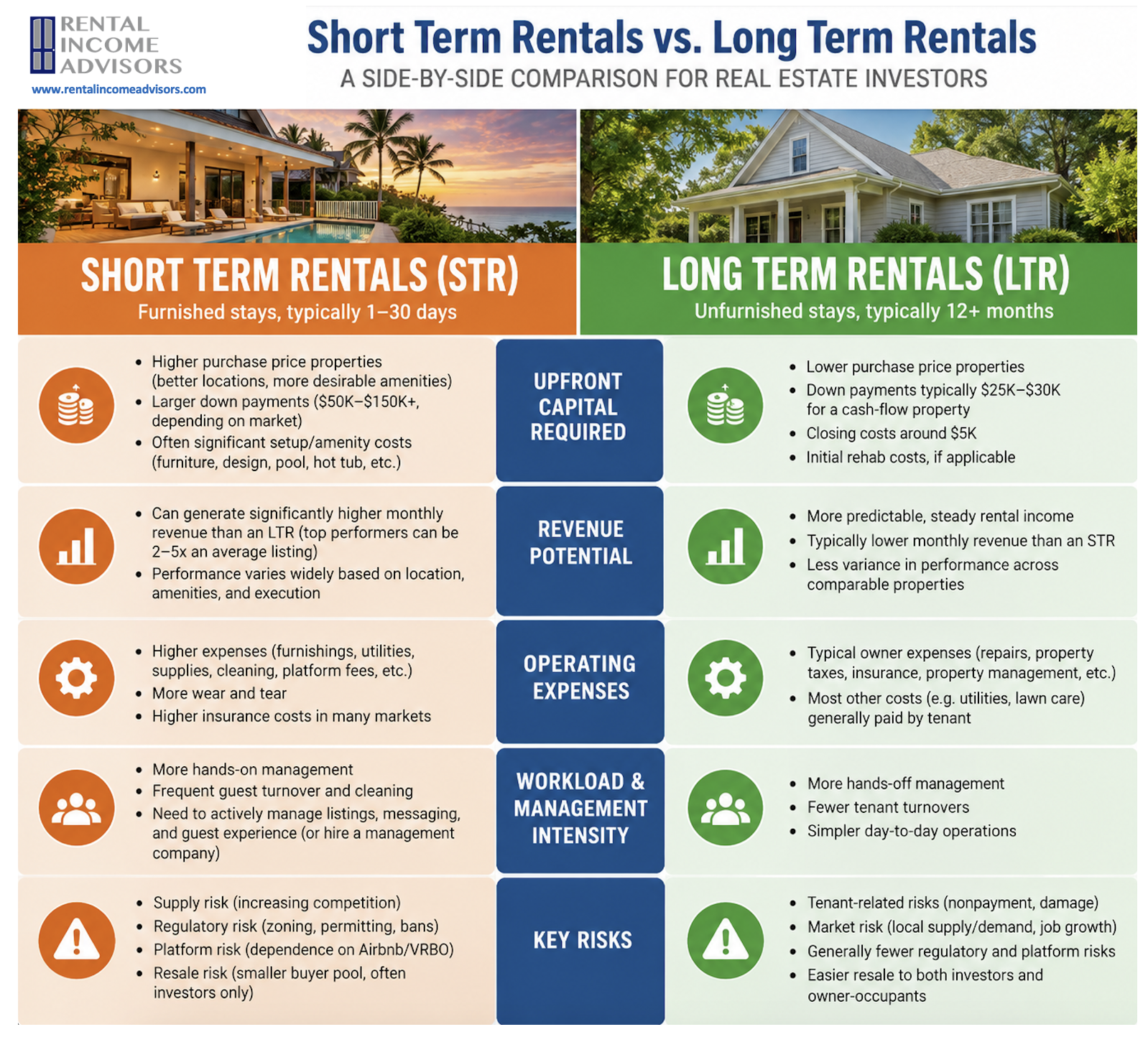
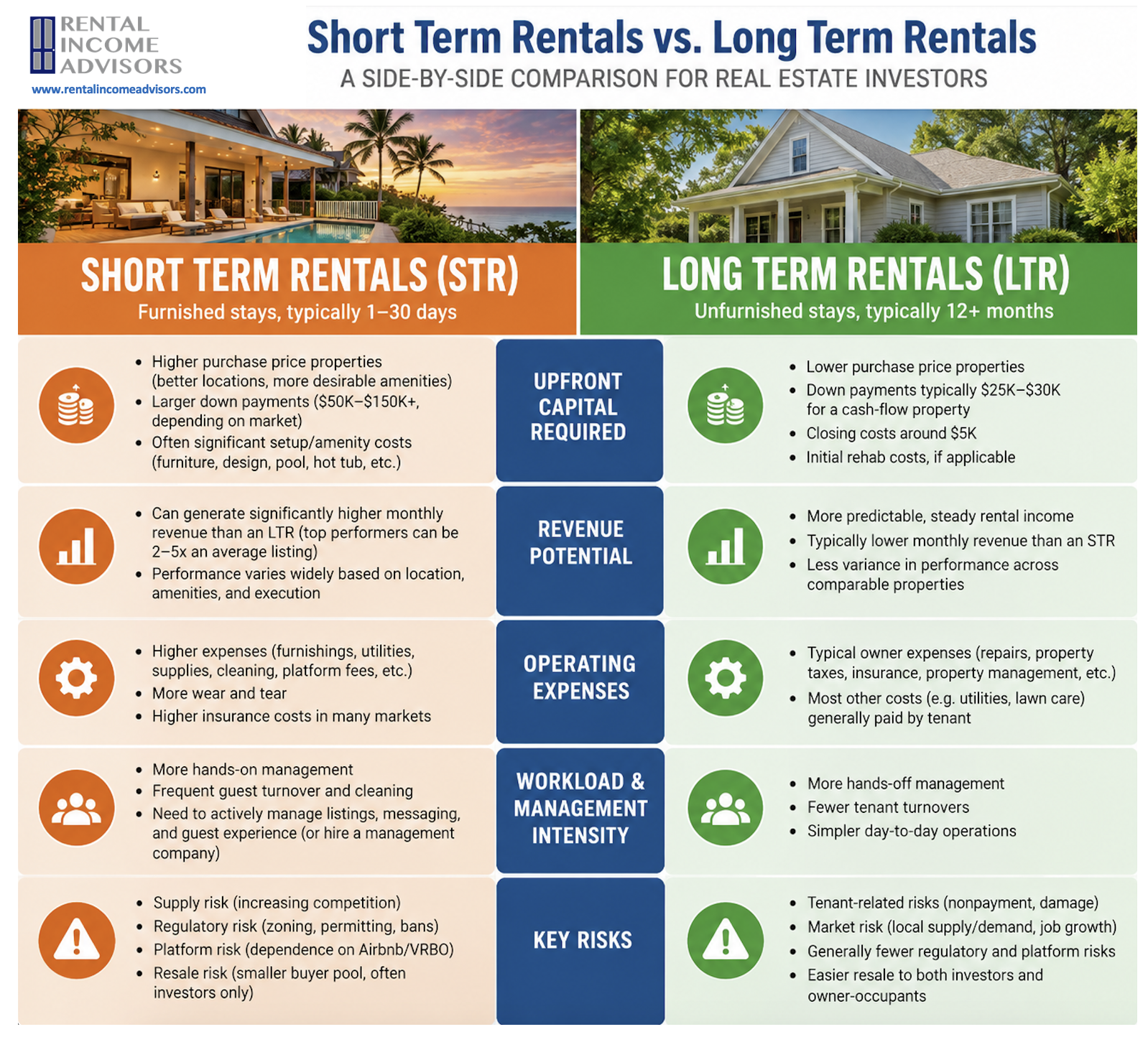
Because I can’t help myself, I’ve summarized the key points of the discussion in my preferred “one-pager” format. You can download it for free:
Just to set some clear boundaries on the discussion, here are some topics I will NOT be discussing in the article:
Things that are basically equivalent in the two models, such as financing, insurance, and the power of long-term leveraged appreciation.
The idea that you can use your AirBNB as a vacation home. I want to keep the focus on these two models as pure investments without muddying the waters with lifestyle considerations.
Bonus depreciation and the so-called “STR loophole.” Deciding to launch STRs because of a tax strategy that only provides benefit in the first year is the tail wagging the dog. While this strategy may be quite attractive for certain investors, it should be the icing on the cake, not the cake itself.
OK, let’s get into it!
1 STR vs. LTR: Upfront Capital Required
The upfront capital required for a long-term rental consists of three pieces:
A down payment (at least 20%, typically)
Closing costs (variable based on market and property)
Initial rehab costs, if applicable
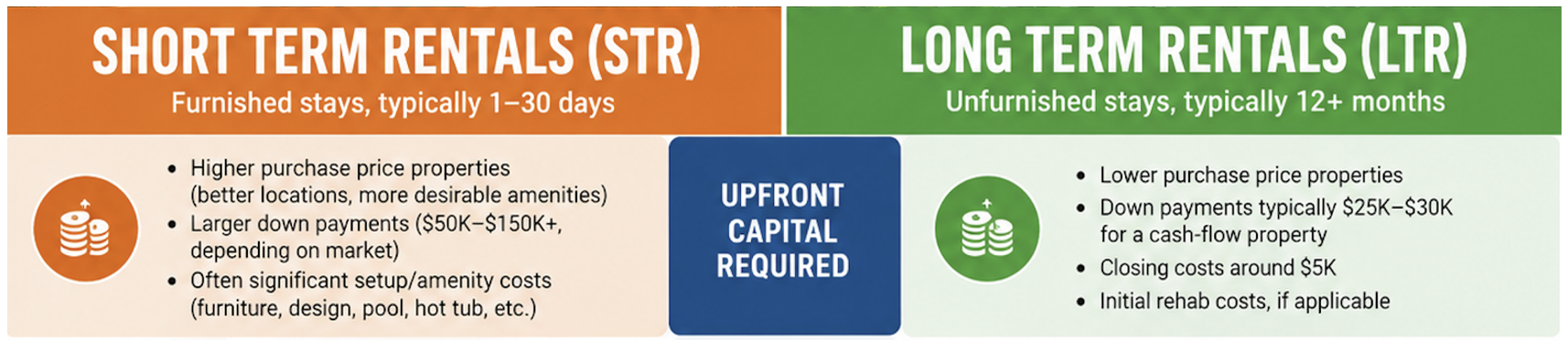
For a typical cash-flow property (like the ones in my portfolio), the down payment would be $25K-30K and the closing costs $5K. That means for a rent-ready property with no initial rehab, you can start investing in LTR with as little as $35K.
For a short-term rental, though, initial costs are typically much higher. There are several reasons for this. First, the property itself is likely going to be more expensive — which brings us to a key principle of STR investing: to the winner goes the spoils.
Here’s what I mean by that: with LTRs, performance is relatively predictable, and rental homes are much the same as each other. You’re competing against other landlords, of course, but the range of results is pretty narrow. Some operators will do better than others with largely similar homes, but not THAT much better.
The opposite is true with STRs, where top-performing listings can bring in up to 5x the revenue of an average listing. To achieve those outsized returns with your STR, you have to compete effectively on location, walkability, views, home size, number of bedrooms, finishes, architectural details, and more.
So you can’t just buy any house. To really win at the STR game, you have to buy a very desirable house in a great location, which of course costs more. That means your down payment could be more like $50K-$150K, depending on market.
And then there are the amenities, which STR owners spend big on in order to achieve that “top listing” status and keep demand high for their properties — things like a pool, hot tub, game room, theater screening room, and much, much more.
To illustrate that point, I had a coaching client who had scaled a sizable LTR portfolio who decided to try his hand at STR. He spent nearly $100K to rehab and outfit his Airbnb, with particular focus on making the backyard a unique and memorable destination with the addition of a playground, fire pit, bar, pool, movie projector, and pickleball court.
I mean, just look at it:

This is a maximal example, but the point very much holds: you’re competing on all fronts with an STR, and the goal is to become one of the top listings in your market because that’s where the biggest returns are.
Clearly, LTR and STR are different games, requiring a different set of properties and wildly different paths to bringing those properties online. They also require much different capital outlays: a typical “boring rental property” like mine can be acquired with a $35K investment, whereas a successful STR will typically require $100K-$200K, or even more.
So, in summary:
2 STR vs. LTR: Revenue Potential
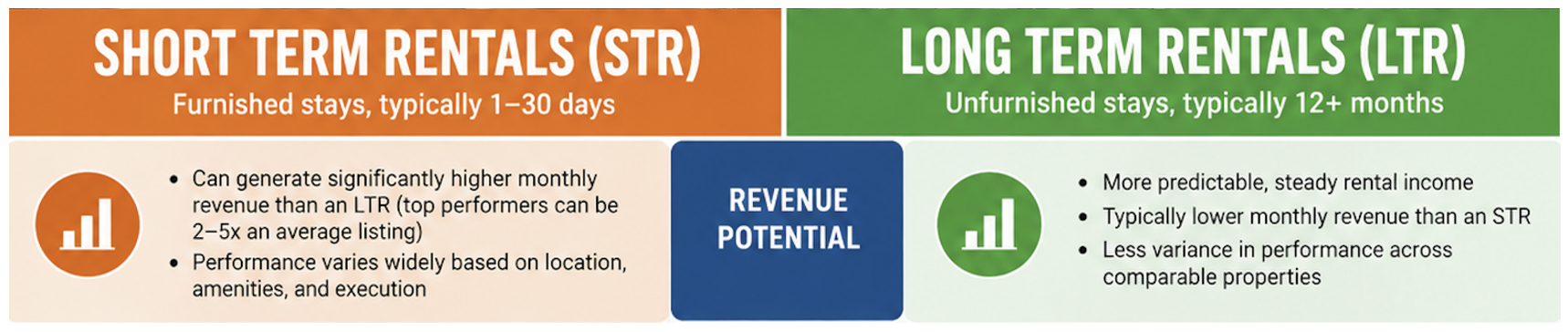
I hinted at this in the previous section, but there is no doubt that STR offers the opportunity to produce more revenue than a LTR.
I’ll reiterate an important point here, which is that the house you’d buy as a STR is often NOT the same house that you’d buy as a LTR. Nevertheless, let’s attempt to do an apples-to-apples comparison here — and let’s use that same Airbnb listing to do it.
Had the house in question been rented to a long-term tenant, it could have fetched ~$3K/month (without all the backyard additions, obviously.) But as a short-term rental, we would calculate revenue by multiplying the average occupancy by the average nightly rate. Once all the work was done, this property was expected to be occupied 20-24 nights per month at $500 per night, which yields $10K-$12K in monthly revenue — more than 3x what we could get for it as a LTR. (So far, this property has more than met those expectations after launching in early 2026.)
Let’s call this the STR premium: the incremental revenue that’s achievable for any particularly property as a STR compared to its LTR potential. STR operators want this premium to be as high as possible, because they need it cover the higher costs of running a STR, and to justify the additional risks that I’ll discuss below.
3 STR vs. LTR: Operating Expenses
STRs have higher revenue potential, but they also cost more to operate.
Some of the expenses are the same, such as mortgage, property taxes, and insurance. With operating expenses, though, we see a big difference. A while back, I published this article which details exactly what I spend on maintenance & repairs at my LTRs, which is ~$120/month per property on average. This covers regular fixes of things like toilets, HVAC, sinks/showers, electrical, and so on. Tenants typically pay for other expenses such as utilities, lawn care, and pest control.
Of course, a STR would also have those same regular maintenance costs (though probably more because of the increased wear & tear that STRs take from renters.) But there is a LONG list of STR-specific expenses that don’t apply to LTR, and will eat into the STR premium on any given property:
Cleaning between each visit
Laundry/linen service between each visit
Utilities
Internet/Wi-Fi
TV/streaming/cable
Platform/booking fees
Lawn service/snow removal
Pool service, if applicable
Security cameras/service
Appliance & furniture maintenance & replacement (btw, my LTR tenants supply their own appliances, though this is market/neighborhood dependent)
Consumable supplies (toilet paper, paper towels, soap, shampoo, coffee, trash bags, dishwasher pods, etc.)
Replace/refresh of linens & towels, kitchenware, and small household items (hair dryers, irons, hangers, remotes, lamps, etc.)
Lodging/occupancy taxes
If this feels like a lot, that’s because it is. That’s why you need your STR premium to be high enough such that it covers all these costs.
But there’s one more cost we haven’t discussed, which also significantly impacts the experience of a STR vs. a LTR investor: ongoing management.
4 STR vs. LTR: Workload & Management Intensity
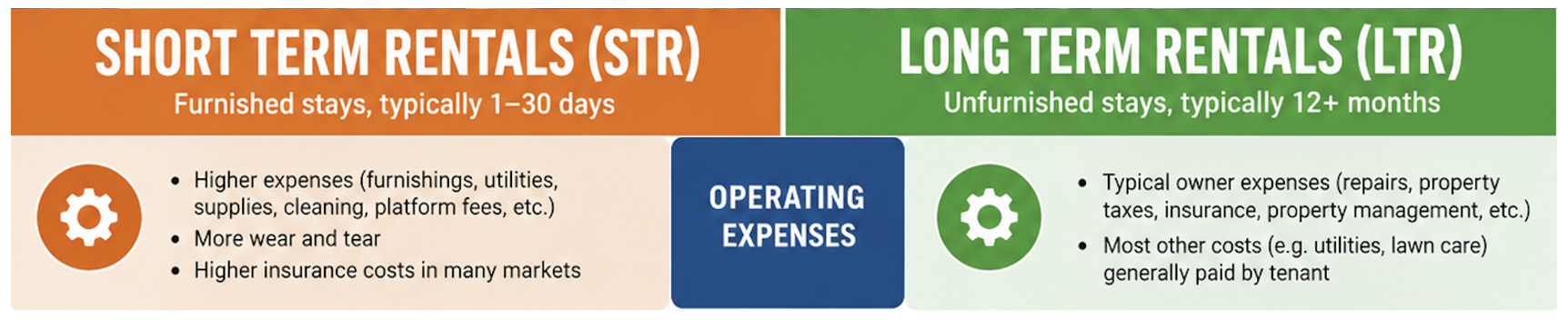
In truth, a STR isn’t a real estate investment at all — it’s a very small hotel business. And I think we’d agree that running a hotel is harder than managing LTRs.
Although, to be fair, running a portfolio of LTRs isn’t the simplest job in the world either. It involves screening & placing tenants, abiding by local housing laws, dealing quickly with maintenance issues, performing preventative maintenance & inspections, collecting rent, evicting tenants, and much more. That’s why I’m a huge proponent of professional property management for LTR investors. This generally costs 8-10% of rents, but it’s a very good trade to buy your time back; plus, a good PM will perform all of these functions better than you anyway.
STR management is even more complicated because of the constant turnovers, the guest communications that are required, the various software tools needed to run the property efficiently and optimize revenue (i.e. dynamic pricing), and more. Self-management can dramatically improve STR economics, but even with a single property you've essentially purchased yourself a part-time job, which is not the experience most investors really want.
That’s why many busy STR owners are increasingly turning to professional STR managers. These firms offer certain services a la carte, but they can also take over full responsibility for your listing so that it’s completely hands-off for you: they’ll handle optimizing the listing, communicating with guests, completing turnovers, coordinating vendors, etc., so that you just get the check at the end of the month.
So what’s the downside of STR management? It will cost you 20-30% of your revenue, or 2x-4x the fee of a LTR.
Once again, we see much higher costs on the STR side of the ledger, which means you must realize a significant STR revenue premium in order for STRs to be a more profitable investment than LTRs. If you achieve a high STR premium and become a “most favorite” listing, your STR will be a winner vs. LTR; however, if you don’t (and by definition, most listings are NOT in the top 5%), then your numbers will be much more challenging.
But there’s more to this equation than just the ROI numbers. There are several other risks to consider.
5 STR vs. LTR: Risks
To recap what we’ve covered so far: STRs offer a significantly higher revenue and ROI potential than LTR, but the reality is:
They require more upfront capital
They are costlier and more complicated to run
They require you to compete on amenities (forever)
They have much higher variability in results
If done right, your ROI with STRs can be outstanding. But only a small percentage of STR operators will be the “cream of the crop”, and those listings will consume the lion’s share of overall STR profits in your market. Most “average” listings will struggle to be profitable.
But there are some further risks to think about when it comes to STRs.
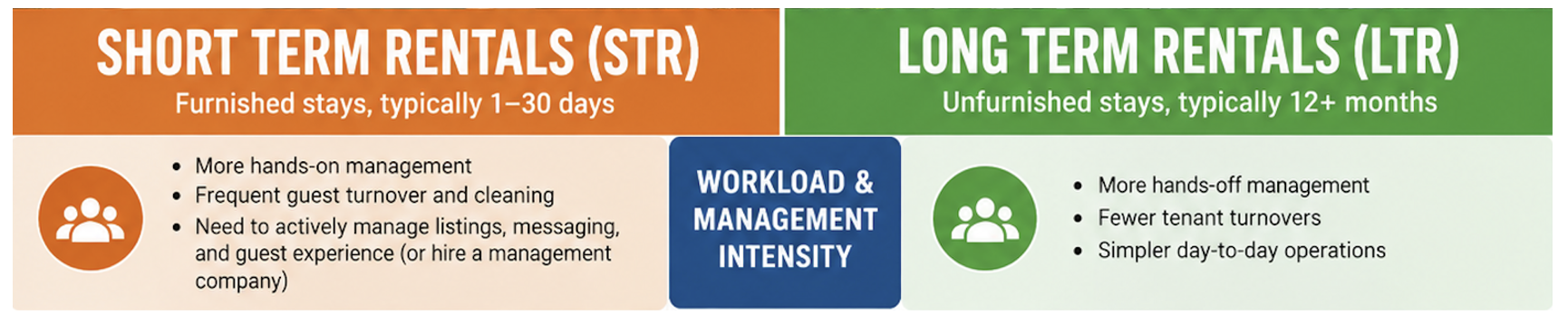
Supply Risk
Here’s the fundamental problem: there is no limit to the growth of STR supply. More and more people can decide they want to run STRs, and getting in the game is easier than ever with companies available to help you pick, rehab, and operate your STRs. As markets increasingly become saturated with STRs, overall margins in the business will compress, and it’ll become more difficult to achieve high rates of return.
And in fact, that’s exactly what we’ve been seeing in the last several years. While AirBNB’s overall bookings and revenue continue to grow robustly — in other words, demand is growing — supply is growing even faster, and driving average occupancy rates down for STR operators.
Exact national data on this is tricky to come by. There are numerous STR data sites (such as AirDNA) that speak to occupancy rates, and many still claim that occupancy is hovering in the 50-54% range. Yet AirROI shows that it’s highest occupancy markets are in the mid-fifties, and it goes down from there; meanwhile, Rabbu’s site showed a 39% average occupancy in Sept 2026. So it’s tough to know the real truth — all these companies are in the STR space, and can tilt easily towards STR boosterism. It’s certainly true that most online discussion among operators indicate significant downward trends in occupancy and profitability in the last few years as listing growth has outpaced demand growth.
This is the risk that scares me the most about STRs. There’s just no way to solve this fundamental problem as a STR investor; the supply just keeps growing, and the resulting margin compression seems to be very real.
Meanwhile, on the LTR side, we have a long-standing supply shortage of homes (which is not helped, ironically, by the more than 2 million homes currently operating as STRs.) That supply shortage works to the advantage of LTR investors, in a perfect photo negative of the supply glut that is making STRs an increasingly difficult business.
Despite this, the very best STR listings are still crushing it. Everyone else…not so much.
Regulatory Risk
In many places, local governments have established new rules that constrain the activities of STR operators. This is true in my hometown of New York City, which no longer allows STR stays shorter than 30 days. Many other places have taken similar actions, or attempted to outright ban short-term rentals.
The issue is this: if there are too many STR listings, local residents don’t like it. They don’t like people coming in and out of their neighborhoods with luggage all the time, but they also don’t like the impacts (real or perceived) on local home prices. This drives local lawmakers to take regulatory action against STRs, which is a real risk if you’re thinking about putting a bunch of money into an STR investment.
These regulatory actions are happening all over the country (and the world), and many more places are considering restrictions. Here’s a useful list of US markets with the harshest rules. It’s a long list, and it will likely grow.
Platform Risk
STR operators are extraordinarily reliant on a single company: AirBNB. (There are other platforms, of course, like VRBO, but AirBNB is dominant.) This poses a real risk over the long-term.
Should we be concerned that AirBNB will go out of business? No — but there are still risks. For example:
AirBNB could change the way users find listings, or the way listings are ordered/prioritized, which could cause your listing to show up less often and bookings to drop
AirBNB could change the way that prices and fees are presented on the site (as they did in 2025), which could impact your business
AirBNB could decide to change they way they collect fees, leaving operators with a smaller cut
Like many other people who run online businesses, I’ve learned how powerless I truly am against the algorithmic changes that big tech companies make. I’d personally prefer not to subject my real estate investments to the same kind of platform risk.
Resale Risk
If you go all out with your STR property by, say, building a pickleball court in the backyard, what will that do to the property’s resale potential?
To compete and win at the STR game, your property really needs to stand out in a crowd; it needs to offer experiential amenities, and attract people looking for a memorable stay or vacation.
But those are not necessarily the same things that a typical homeowner wants. Think about it: you’d probably be attracted to that AirBNB listing with the amazing backyard and the pickleball court, etc. — but would you want that to be YOUR backyard?
This creates the risk that in optimizing for STR performance, we’re not optimizing for resale. Obviously, this only applies to certain AirBNB properties, but as competition for those “top spots” on AirBNB heats up and amenities become more extravagant, it’s something to think about.
Conclusion
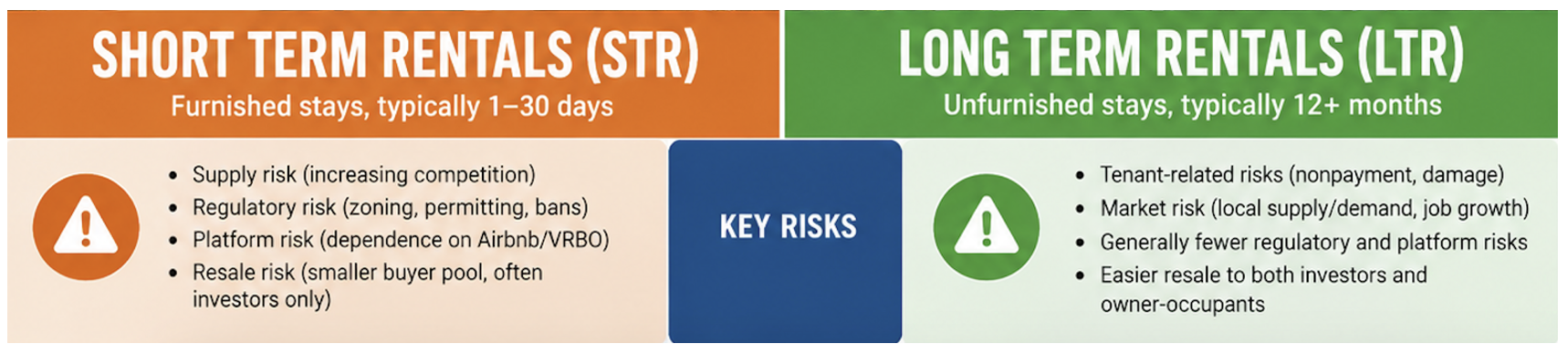
It’s clear that STRs and LTRs are very different propositions. While many investors think about them as two sides of the same coin, they’re really not — STRs are actually more a hospitality business than a real estate investment.
STRs require more initial capital, they cost more to operate, they’re more intensive to manage, and they come with specific risks that LTRs don’t. But if you out-compete most other operators, they also have much higher potential financial returns.
Which one is right for you? Well, that depends on you. If you can accept the risk/reward proposition of STRs and you’re willing to do what’s needed to outperform your competition, they could be a great fit. However, if you’re looking for a more stable, predictable, passive, and de-risked long-term investment, and/or you have somewhat limited capital to start with, then LTRs are probably a better fit. (And of course, some people eventually try their hand at both.)
Still, I’d say that LTR is the easier, more accessible, and preferable strategy for most investors. The numbers bear this out: despite the growth in STR listings, there are still 15+ rental homes for every AirBNB. That means that most rental investors are like me: as tempting as STRs look, they decide that LTRs are the better path.
Finally, here is that one-pager graphic one more time, and the link to download it for free:
About the Author
Hi, I’m Eric! I used cash-flowing rental properties to leave my corporate career at age 39. I started Rental Income Advisors in 2020 to help other people achieve their own goals through real estate investing.
My blog focuses on learning & education for new investors, and I make numerous tools & resources available for free, including my industry-leading Rental Property Analyzer.
I also now serve as a coach to dozens of private clients starting their own journeys investing in rental properties, and have helped my clients buy millions of dollars (and counting) in real estate. To chat with me about coaching, schedule a free initial consultation.






















As AirBNB continues to grow in popularity with travelers, many investors are wondering whether STRs or LTRs offer the best returns. This article goes deep on all the pros and cons between the STR and LTR investment models.