

Greetings, investors!
It’s been a minute, so let met share a few personal/business updates. The holidays are here, and that’s typically a very busy time of year — but that was especially so for me this year because I decided to travel for several weeks in November. First it was Las Vegas for six days to play some poker (results: tournaments were OK, cash games were awesome.)
While I was in Vegas, I stopped by the studio of John Gafford as a guest on the Escaping the Drift podcast. We chatted about my early work experiences (Cheesecake Factory!), how introverts can succeed in sales and management roles, and of course real estate investing. Fun conversation, check it out!
From there, it was on to the spectacular Dunton Hot Springs in Colorado, where I met up with my husband, brother, and sister-in-law. This is definitely one of my favorite places on earth, and we had such a memorable time — including seeing the Northern Lights for the first time!



Once back home, I had to scramble to get caught up on work, but it’s a price well worth paying in exchange for the freedom & flexibility I have — just one of the many things I was grateful for this Thanksgiving.
With the good weather dwindling, we somehow managed to get in one more round of golf here in Virginia in mid-November. A chilly day, but nice enough — and check out that sunset!


Actually, the 50-year mortgage isn’t a terrible idea
While it looks increasingly likely that the 50-year mortgage — an idea floated last month by the Trump administration in order to address the affordability of housing — will NOT actually happen, I nonetheless couldn’t resist publishing a deep dive on the topic.
Why? Because a lot of people have been saying a lot of pretty dumb things about it, which drives me a little nuts.
That deficit of thoughtful public commentary created fertile soil for me to take my typical data-driven approach and examine whether a longer-term mortgage would be good for investors. Turns out — it actually might be, despite all the hate this proposal has been getting on the internet.
Here’s a little taste:
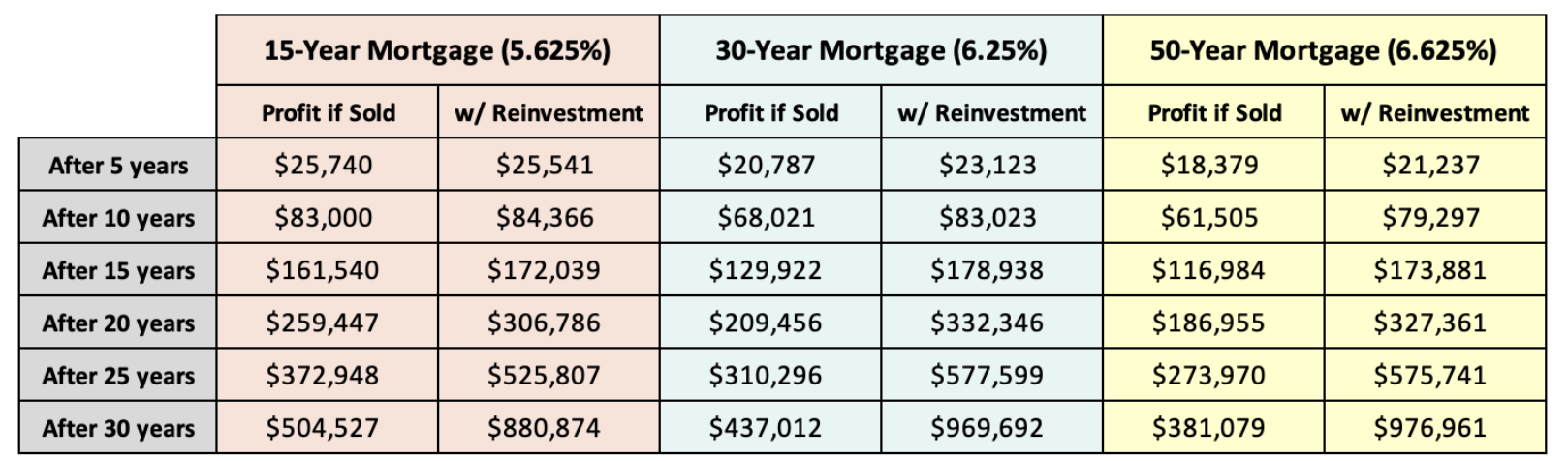
Check out the full article for all the details on how I calculated these figures, and much more. (BTW, wondering about the pros & cons of a 30-year vs. 15-year mortgage? The article answers that question too.)
Real Estate News & Data
How the mighty (markets) have fallen
A recent ResiClub analysis shows that markets with the biggest price increases in the 2020-2022 period have fared the worst since then. You might already know that Austin, TX is the poster child for this, but the pattern is broad and unmistakable across markets:
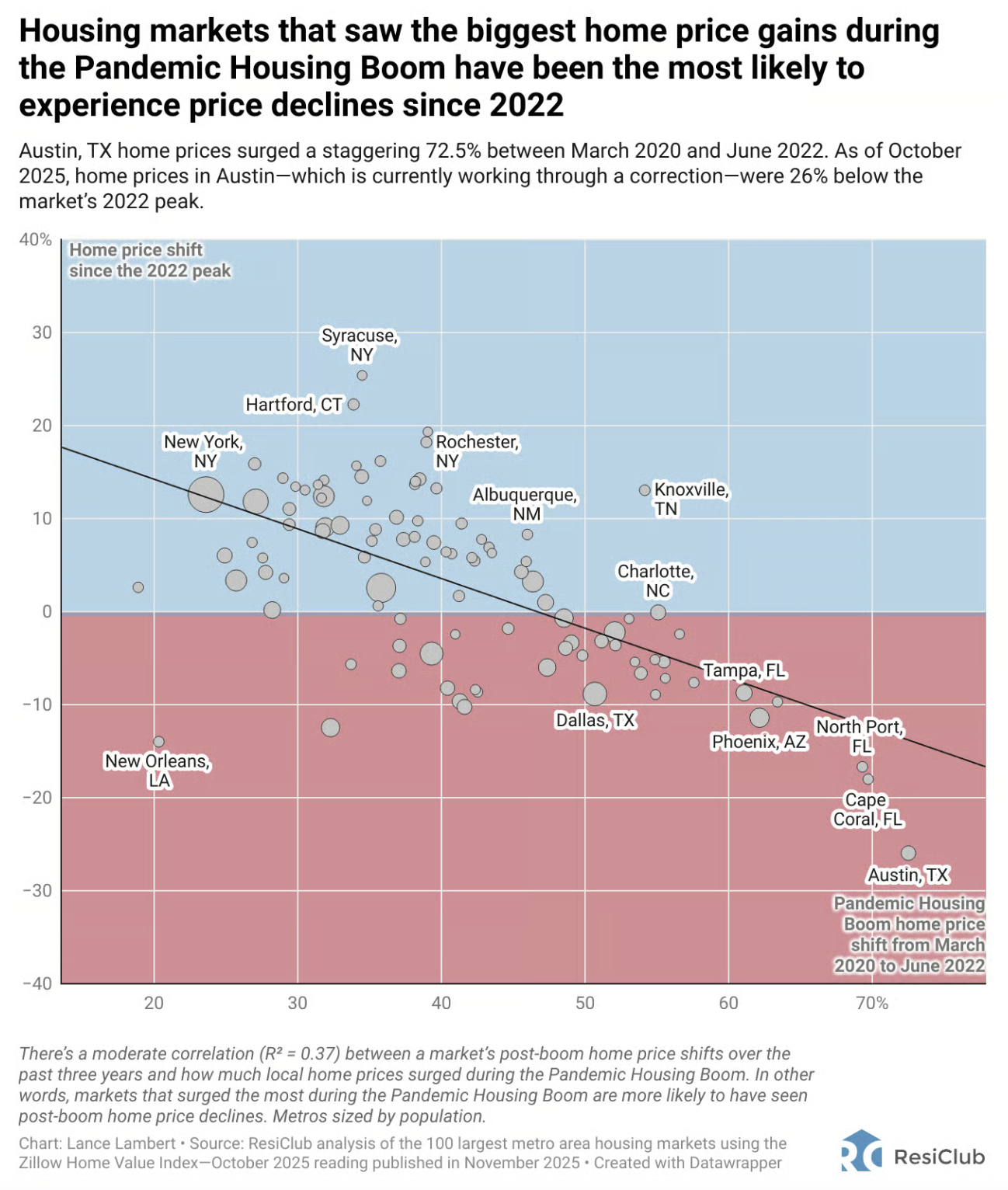
This is classic reversion to the mean; what goes up must comes down. (Or, more precisely, markets that display anomalous performance over a given period are more likely to eventually be anomalous in the other direction.)
It also further underscores the risks of attempting to use recent history/data to predict future home price appreciation; quite clearly, anyone who took this approach around 2022 has gotten torched.
Credit scores in the spotlight
We’re quite accustomed to the ubiquity of credit scores — they’re used in all sorts of contexts to assess financial risk, and credit reporting has been integrated into the interfaces of most major banks and financial institutions. It feels like our credit scores are everywhere, all at once.
But that may be changing: Michigan is attempting to ban the use of credit scores in rental applications, and allow for the sealing of eviction records.
Both these tools are critical for landlords and property managers to assess the financial risk of placing a given tenant. I believe tenant protections are important, but I don’t agree with this policy proposal.
Separately, Fannie Mae announced that it will no longer enforce a hard requirement of a 620 credit score for conventional mortgages. This impacts the Desktop Underwriter (DU) system, the automated application lenders use to obtain loan approvals. Previously, any score of 620 would automatically be denied; now, the system MAY approve lower credit scores if a combination of other financial behaviors/factors are favorable.
The devil will be in the details on this one. If this is used judiciously, the impact will be small (and likely positive). But if approval criteria are significantly loosened, riskier loans will flood the market and increase systemic risk. Let’s not repeat 2008, shall we?
The Latest in My Portfolio
I’ve updated my portfolio tracking figures through the end of November. October was another great month with ~$15K in cash flow, but two unexpected turns in November set me back.
Remarkably, one of those tenants vacated suddenly because of fear about the ICE raids in Memphis. He is a permanent legal resident, but was nonetheless fearful about what might happen, so he left town.

And now this!
This month’s Roundup is sponsored by Obie.
Obie is a leading online provider of landlord insurance to real estate investors. I’m a fan of Obie because they have the fastest policy quote and binding technology, reducing the need for tedious forms and extended wait times. Their online quote process is incredibly fast and seamless, and lets you tailor your insurance coverage to what you need.
Learn more about Obie here, or get an instant quote.

Well, That’s Interesting…
How much does it ACTUALLY take to just live a “normal” life these days?
Michael Green took a close look at how the government calculates the “poverty line”, and found an outdated methodology based solely on food costs that hasn’t changed since the mid-1960’s. While the federal poverty level for a family of four is currently about $35K, Green argues it should be well north of $100K, and perhaps as high as $140K.
This is the rare Substack post that went truly viral — this discussion has been EVERYWHERE in the past few days.
I take issue with some of the specific math in his piece, but his larger point about affordability is pretty irrefutable.
Also: Part 2 just dropped, where he goes after the critics of his first piece. Grab the popcorn!
Eric’s Picks
Article: Some renters are conning their way into luxury apartments using fake pay stubs, financial statements, and personal identification documents. This type of fraud has accelerated due to the availability of generative AI tools. To weed out these bad applications, landlords increasingly rely on fraud-detection and verification technology — which are ALSO using AI to improve.
Article: A look at how climate risk is impacting home values. Great reporting from the New York Times with some excellent data visualizations.
Political Analysis: I really enjoyed this WIRED piece from Stevey Levy exploring how Silicon Valley came to embrace the right. It made me nostalgic for a time when I believed (naively) that tech companies were bold innovators challenging entrenched power and old ways of thinking. Now that their own power is entrenched, they seem willing to do whatever it takes to preserve that...in other words, they’re just like all other companies that came before them.
Data Analysis: The average age of a US homebuyer just hit 40 years old. As recently as 2010, it was 30 years old.
Book: I just finished “Die With Zero”, by Bill Perkins. The author makes a provocative case that many of us are saving too MUCH money for our golden years, rather than spending it earlier when the range of experiences available to us is broader/deeper. He also argues that inheritances and charitable giving should be done while you’re living, rather than as a lump sum after you die.
More interesting stuff:
Not long after adding it, Zillow removed flood risk assessment from its listings, replacing them with a hyperlink, following complaints from the California MLS. Real estate agents and brokerages were apparently concerned that homes with flood risk would sell for less. Well…yeah, that’s kinda the point of assessing flood risk in the first place.
Don’t miss this incredibly reported piece from Reuters detailing the Trump family’s crypto ventures, which have earned them nearly $1B so far in 2025, mostly from foreign sources. As recently as 2021, President Trump called cryptocurrency a “scam”.
Fix a Typewriter, Fix Your Life. This might be the best thing I’ve read in a while, and speaks powerfully to the idea of recapturing purpose in your work. Seriously, just read it.
About the Author
Hi, I’m Eric! I used cash-flowing rental properties to leave my corporate career at age 39. I started Rental Income Advisors in 2020 to help other people achieve their own goals through real estate investing.
My blog focuses on learning & education for new investors, and I make numerous tools & resources available for free, including my industry-leading Rental Property Analyzer.
I also now serve as a coach to dozens of private clients starting their own journeys investing in rental properties, and have helped my clients buy millions of dollars (and counting) in real estate. To chat with me about coaching, schedule a free initial consultation.
Free Rental Property Analyzer
You probably know that a well-designed rental property calculator is the most important tool a real estate investor has. It allows you to quickly calculate key metrics and understand your cash returns on a target property. You can also answer questions like:
How much do your cash-on-cash returns improve if you use a mortgage vs. paying in cash?
What will your average monthly cash flow be?
How will your returns change in future years?
Those questions can be easily answered with side-by-side comparisons in the RIA Property Analyzer. I guarantee this is the best free rental property calculator out there today, and many of my readers have told me the same. It’s both powerful and very simple and intuitive to use. Check it out!








An update on home price trends across the country. Also, tax season is no problem for the rich, and the latest World Happiness Report.